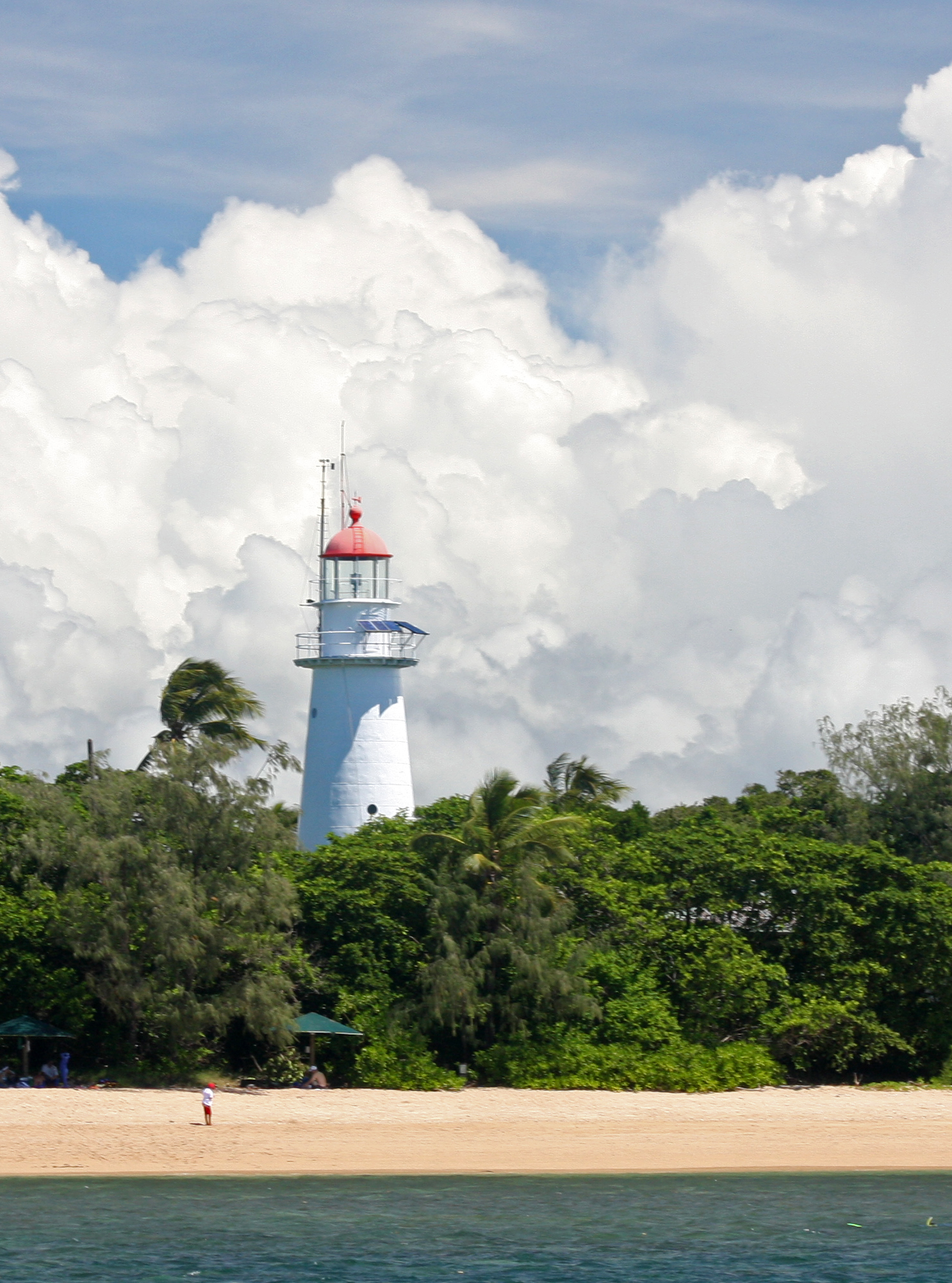
Photograph courtesy of Wikimedia Commons contributors. Used under Creative Commons licence.
About Low Isles Light
Low Isles Light, also known as Low Islets Light or Low Island Light, is an active lighthouse located on Low Island, a coral cay which together with Woody Island forms the Low Isles group, about 13 kilometres (8.1 mi) northeast of Port Douglas, Queensland, Australia. The island is situated on the western edge of the main shipping channel into the harbour of Port Douglas, and it marks the entrance to the channel.
Built in 1878, it was the first lighthouse in Far North Queensland and more specifically the first to light the Inner Passage of the Great Barrier Reef. Its construction is typical to Queensland lighthouses of the time, timber frame clad with galvanized iron, and it is the fourth lighthouse of this type constructed in Queensland, though it is the first of them to use portholes. The lighthouse was recommended in February 1876 but construction of the lighthouse and cottages, by W.
P. Clark, started more than a year later. The structures were ready and the light was lit in late 1878. The original oil wick light was upgraded to kerosene in 1923, to electricity in 1963 and finally converted to solar power in 1993, when the station was demanned. The size of the island mandated a rather compact circular pattern of structures.
Other than the lighthouse, none of the original structures survived, the keeper residences being rebuilt in the 1960s. One of the residences now serves as a research station. The station is owned and managed by the Queensland Parks and Wildlife Service. The site can be visited but the tower is closed.
Visiting Low Isles Light
- Location: 16.3841°S, 145.5598°E — view on Google Maps
- Nearest town: Port Douglas, Queensland (15 km south-west) — see accommodation in Port Douglas
- Access: Conditions vary by site. Some lighthouses sit on public headlands with car parks and interpretive signage; others are on islands or in active marine reserves requiring a boat or permit. Check with the relevant state parks service or heritage body for current access, opening times and fees before visiting.
Further reading
Read more on Wikipedia → — used under CC BY-SA 4.0. This article includes contributions from the Wikipedia community.