Photograph courtesy of Wikimedia Commons contributors. Used under Creative Commons licence.
About Point Stephens Light
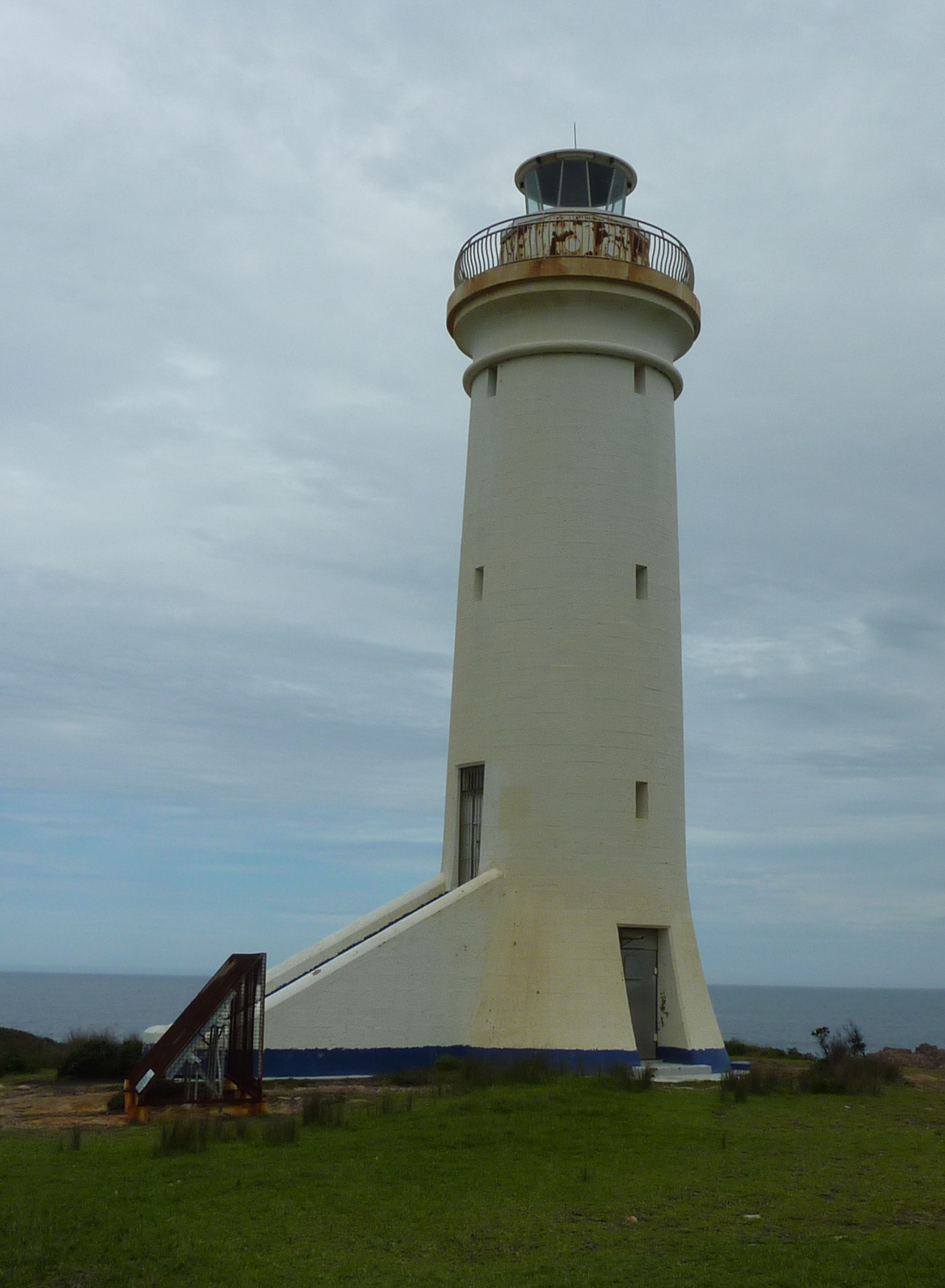
The Point Stephens Light is a heritage-listed active lighthouse located on Point Stephens, a point on an unnamed headland at the east of Fingal Bay, 4.25 km (2.64 mi) south of the entrance of Port Stephens, New South Wales, Australia. The light serves to assist vessels entering Port Stephens. It is considered an endangered lighthouse due to remote location and old age.
Proposed in 1857, the heritage-listed lighthouse was built in 1862. Designed by Alexander Dawson, the New South Wales Government Architect at that time, both the lighthouse's flared base and the keeper's cottages combined terrace are unique architectural features for the period. The light source used was originally kerosene lamps, which upgraded in 1912 to a Dalén light, upgraded again to electric light in 1960, automated in 1973, and finally converted to solar power in 1990. In 1991, the last caretaker withdrew from the premises and very soon after the keeper's cottages were vandalised and burned.
The tower is designed in the form of a Doric column. It is divided into four stories with a spiral stairway, and topped by a gallery carrying the lantern. The keeper's cottages are three one story cottages, sharing a roof. Other structures which still stand at the location are a circa 1930 privy and workshop built in the 1950s.
The lighthouse is managed as part of the Tomaree National Park. Access to the lighthouse is difficult, either through a narrow spit of sand at low tide or by boat.
Visiting Point Stephens Light
- Location: 32.7456°S, 152.2017°E — view on Google Maps
- Nearest town: Nelson Bay, New South Wales (6 km north-west) — see accommodation in Nelson Bay
- Access: Conditions vary by site. Some lighthouses sit on public headlands with car parks and interpretive signage; others are on islands or in active marine reserves requiring a boat or permit. Check with the relevant state parks service or heritage body for current access, opening times and fees before visiting.
Further reading
Read more on Wikipedia → — used under CC BY-SA 4.0. This article includes contributions from the Wikipedia community.